Normalization
The Glass RoomNormalization names the threatened reversal of political change: after a short-lived opening, the old order and its compliant officials may return. In the novel, the term emerges during Liesel’s late visit to the Glass Room, where the public language of architectural heritage stands uneasily beside the family’s unresolved history of confiscation, exile, and loss.
A political opening and a disputed invitation
The city of Město invites Liesel to witness the handover of the house, offering to pay her expenses and presenting a letter from the ambassador. Martin warns his mother that accepting could amount to de facto recognition of the city’s legal ownership. The invitation is therefore both an opportunity to return and a dispute over what that return might concede: a ceremonial visit could be read as assent to the confiscation that separated the family from its home.
Veselý argues that the political circumstances have changed. He describes the invitation as part of an effort to restore normal relations with neighboring countries, open the country to the West, and acknowledge past errors. Martin rejects this account as an attempt to use his mother in a political game. Veselý answers that the stakes are not abstract for the people of Czechoslovakia; Liesel’s visit might help them. The exchange makes the invitation’s meaning unstable: it can be a claim about property, an appeal to political reconciliation, or both.
Private history breaks into public time
The discussion changes when Liesel’s family reads a letter revealing that Hana is alive. Liesel says that they had believed Hana dead: they had heard of her arrest and deportation in 1942, when the family was in Cuba. After the war, confusion over the expulsion of Germans and the movement of displaced people made information difficult to obtain; the Iron Curtain then seemed to cut the country off altogether. The news turns the invitation into more than a question of a building’s ownership: it opens a way back into a history of separation that the family had thought irretrievable.
The family’s losses are not interchangeable. Liesel recalls that her own family had left Moravia, while her husband’s Jewish relatives were killed in the camps, including Auschwitz, Sobibor, and Treblinka. The revelation of Hana’s survival arrives amid these histories of murder, displacement, and political division. The scene presents the past not as something settled by a change in official language, but as something that can return suddenly through a letter and unsettle the present.
The Glass Room after the invasion
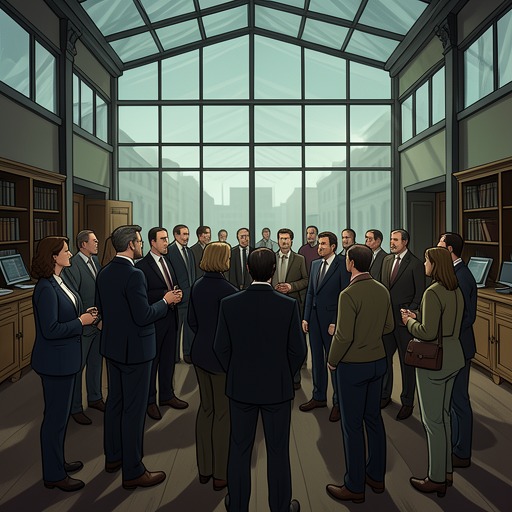
At a gathering in the Glass Room, Liesel is hemmed in by the crowd while a city official gives a speech praising the house’s place in European architecture. She asks Hana to take her outside. The movement from the room to the terrace gives their political conversation a private space, away from the ceremonial account of the building.
Liesel says she never trusted Laník and thinks he used to spy on her. Hana replies that he is now a Party official, comparing his rise to the promotion of the soldier Švejk to captain. She describes the country as having been governed by people like him, and sees the return of the Soviet army as a bitter reversal just when change seemed possible. When Liesel asks what will happen next, Hana answers that Normalizace is what they call it: the Švejks, she supposes, will return, if they ever really left. The term carries both political expectation and weary doubt; change may be declared, but the habits and personnel of power have never fully disappeared.
An ageless room, a changing history
The host’s speech presents the Glass Room as a jewel of modern domestic architecture, while Hana and Liesel’s conversation registers what that polished public description cannot contain: surveillance, political reversal, and the uncertainty of return. The room is also described as a place of balance and reason that seems to deny time. Yet the family’s experiences repeatedly bring time back into it, linking the house to confiscation, wartime separation, and the possibility of reunion.
Normalization thus names more than a political period anticipated by Hana. It marks the fear that an apparent opening will give way to familiar forms of control, even as the room’s public use and meaning remain contested. The invitation to witness a handover may create a moment of contact between the city and the exiled family, but it cannot by itself resolve the question of ownership or undo the histories that have divided them.